



State of the Industry Report
Alexandre Sinclair, Director of Revenue Strategy and Commercial Analytics
Hotel Trends Overview October 2026
The U.S. hospitality market is experiencing a significant lift, despite broader global economic pressures and a minor slip in international air passenger demand. This resilience is particularly evident in technology hubs, AI and data center construction sites, and the luxury lodging segment, all of which are outperforming expectations as the industry transitions toward highly integrated, AI-driven operations for 2027.
CBRE Upgrades 2026 U.S. Hotel Outlook Amid ‘Meaningful’ Business Travel Recovery
CBRE Raises 2026 U.S. Hotel Forecast
- RevPAR growth upgraded: CBRE raised its 2026 U.S. hotel RevPAR growth forecast to 2.5%, up from 1.2% at the start of the year.
- Business travel is recovering: The increase is being driven primarily by a meaningful recovery in business transient and group travel.
- Convention demand remains strong: Convention-related RevPAR was up 5.4% year over year through April.
- Business and group travel driving growth: Excluding the impact of the World Cup, CBRE expects business transient and group travel to generate more than half of total U.S. RevPAR growth in 2026.
Markets Expected to Benefit
- Technology hubs: Markets such as the San Francisco Bay Area are expected to benefit from stronger business travel.
- AI/data center markets: Memphis, Houston and St. Louis are positioned to benefit from increased demand tied to data center construction.
- Wyndham seeing similar trends: Wyndham Hotels & Resorts has reported recent domestic RevPAR gains, partly attributed to demand from data center projects.
Broader Industry Outlook
- Other forecasters are also more optimistic: CoStar and Tourism Economics recently more than doubled their 2026 U.S. RevPAR growth forecasts compared with the beginning of the year.
- Occupancy: CBRE forecasts U.S. hotel occupancy of 62.8% in 2026 and 63.0% in 2027.
- ADR growth: Average daily rate is expected to increase 1.7% in both 2026 and 2027.
Performance by Hotel Segment
- Luxury: RevPAR expected to grow 5.2% in 2026, significantly outperforming other segments.
- Midscale: RevPAR expected to increase 0.7%.
- Economy: RevPAR projected to decline 0.6%.
Bottom line: The U.S. hotel outlook has improved meaningfully, with the recovery in business and group travel emerging as a major growth driver. Luxury hotels and markets tied to technology, AI and data center investment are expected to see the strongest performance.
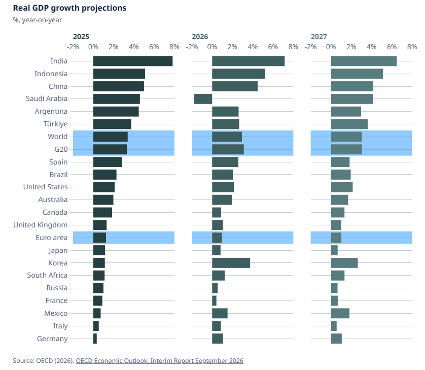
Global growth holds up despite successive shocks, but risks persist
- Global economy remains resilient: The global economy has absorbed the Middle East-related energy supply shock better than expected.
- OECD Secretary-General Mathias Cormann’s assessment: The economy has weathered the energy shock better than expected, but the remaining buffers are shrinking. Governments therefore need to focus support where it is most needed while strengthening the foundations for sustainable long-term growth.
- Near-term risks remain: Persistent inflation and uncertainty surrounding the Middle East conflict continue to weigh on the economic outlook.
- Oil shock has been contained: The impact has been mitigated by:
- Alternative oil supply routes
- Drawdowns of inventories and strategic reserves
- Higher production outside the Gulf
- Lower oil demand, particularly in China
- AI investment supports growth: Strong investment in artificial intelligence continues to boost global trade and economic activity.
- Policy priorities:
- Central banks should remain vigilant and keep inflation expectations anchored.
- Governments need to strengthen the sustainability of public finances.
- Energy-related support should be targeted and temporary to avoid weakening incentives for energy conservation.
- Policymakers should focus on long-term growth by improving skills, diversifying energy supplies, and accelerating AI adoption.
- Global growth outlook:
- 2026: 2.9%
- 2027: 3.0%
- United States: GDP growth is projected at 2.2% in 2026 and 2.1% in 2027.
- Inflation remains elevated: Higher global energy prices are expected to push G20 inflation above previous forecasts.
- 2026: 4.1%
- 2027: 3.6%
- Overall outlook: The global economy is showing resilience, but energy prices, inflation, and geopolitical uncertainty remain key risks to growth.
- Downside risks are increasing:
- Rising long-term government bond yields are adding pressure to public finances.
- A correction in AI-related markets could have broader economic effects.
- Weather-related disruptions could increase commodity and food prices.
Continued geopolitical uncertainty could further disrupt energy markets.
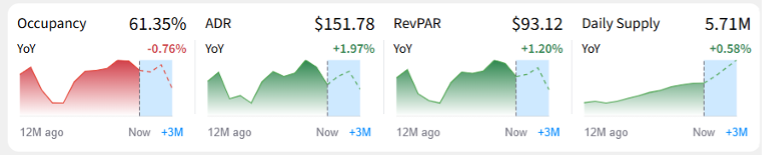
Hotel Performance Overview: Stable Revenue Growth Despite Slight Occupancy Decline
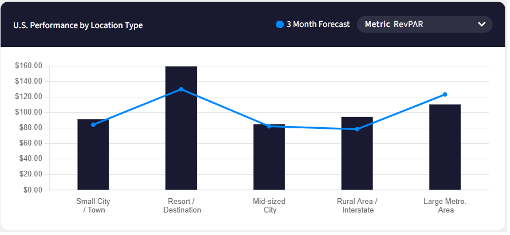
- Resort/Destination hotels lead the market, with forecast RevPAR of approximately $130.
- Large metropolitan areas rank second, with forecast RevPAR around $123.
- Small cities/towns and mid-sized cities show moderate performance, with RevPAR forecasts of approximately $85 and $82, respectively.
- Rural/Interstate hotels have the lowest forecast RevPAR at roughly $78, indicating comparatively softer performance.
Air Passenger Demand Slips 0.8% in August
- Total demand, measured in revenue passenger kilometers (RPK), was down 0.8% compared to August 2025. Excluding the Middle East, demand grew by 0.6%. Total capacity, measured in available seat kilometers (ASK), increased 0.3% year-on-year. The load factor was 85.1% (-0.9 ppt compared to August 2025).
- International demand fell 0.9% compared to August 2025. Excluding the Middle East, demand grew by 1.3%. Capacity was flat (0.0%) year on year, and the load factor was 85.0% (-0.8 ppt compared to August 2025).
- Domestic demand fell 0.5% compared to August 2025. Capacity increased 0.7% year-on-year. The load factor was 85.3% (-1.1 ppt during the same reference period).
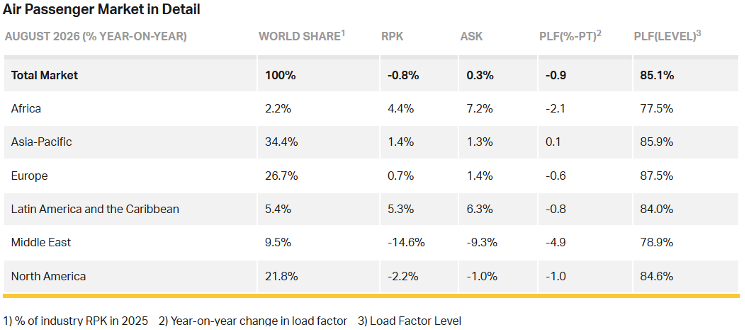
Regional Breakdown – International Passenger Markets
International RPK fell 0.9% year on year, with capacity unchanged. However, excluding the Middle East carriers, total demand rose 1.3% on the same basis.
- Asia-Pacific airlines saw a 0.1% year-on-year decrease in demand. Capacity decreased 0.9% year-on-year, and the load factor was 85.6% (+0.7 ppt compared to August 2025). Traffic on routes within Asia fell 2.0%, and capacity declined for the fourth straight month. By contrast, traffic on the Asia-North America corridor grew by 2.5%.
- European carriers saw a 2.1% year-on-year increase in demand. Capacity rose 2.8% year-on-year, and the load factor was 86.8% (-0.6 ppt compared to August 2025). The Europe-Asia corridor continued to expand strongly (+12.2%), but transatlantic routes fell 2.4%, with traffic declining from several markets, including the UK and France.
- North American carriers saw a decrease in demand of 1.7% year-on-year. Capacity decreased 1.1% year-on-year, and the load factor was 86.8% (-0.5 ppt compared to August 2025).
- Middle Eastern carriers saw a 14.2% year-on-year decrease in demand. Capacity fell 9.0% year-on-year, and the load factor was 79.1% (-4.8 ppt compared to August 2025). Traffic declined further in August, reversing the gradual stabilization trend since the Iran war in February. The year-on-year contraction on Middle East-Asia routes, for example, accelerated to -11.7% from -8.6% in July.
- Latin American airlines achieved a 6.7% year-on-year increase in demand. Capacity climbed 6.4% year-on-year. The load factor was 84.8% (+0.2 ppt compared to August 2025).
- African airlines saw a 6.7% year-on-year increase in demand. Capacity was up 8.3% year-on-year. The load factor was 78.4% (-1.2 ppt compared to August 2025).
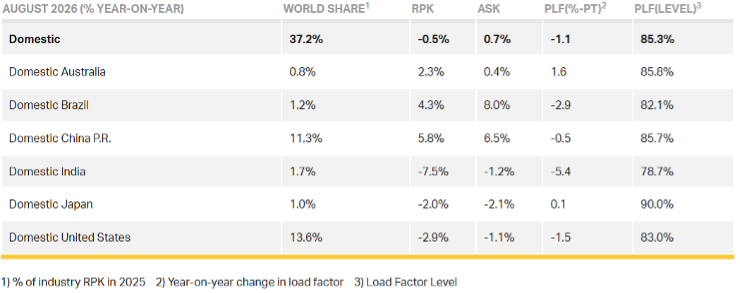
Domestic RPK fell 0.5% in August 2026 compared to the same month last year. Domestic travel in Japan and the United States fell, with a particularly sharp contraction in India (-7.5%). Chinese domestic travel strengthened, supported by summer travel demand.
Hospitality Technology Trends for 2027
- Integrated systems are becoming essential: Hotels are moving away from disconnected technology toward unified platforms that connect reservations, guest data, payments, and operations.
- Agentic AI is becoming more operational: AI is shifting from simple chatbots and recommendations to performing tasks such as rate adjustments, guest communications, and maintenance routing.
- Data connectivity is critical for AI: AI can only perform effectively when it has access to accurate, centralized data across hotel systems.
- Payments are becoming a profit opportunity: Hotels can generate additional value through multicurrency payments, automated invoicing, faster reconciliation, and improved cash flow.
- The focus is shifting when choosing a PMS: Hotels should look beyond individual features and consider how well a system can integrate the entire operation, support future technology, and scale with the business.
- Overall trend: The future of hotel technology is centered on connected data, automation, AI, and turning operational systems into strategic business tools.
In Conclusion
- CBRE Upgrades 2026 U.S. Hotel Outlook from 1.2 to 2.5% RevPAR increase, driven by business travel and most heavily centered in the Luxury hotel class
- The global economy has absorbed the Middle East-related energy supply shock better than expected, supporting the RevPAR gains vs. previous forecasts
- North America and the Middle East are the only regions to see a decrease in YOY RPK (revenue passengers per Kilometer) in August YOY.
- The future of hotel technology is centered on connected data, automation, AI, and turning operational systems into strategic business tools. A strong focus on the future potential of systems and how dynamic they are to evolve is important to consider when evaluating any new tools
Sources