


State of the Industry Report
Alexandre Sinclair, Director of Revenue Strategy and Commercial Analytics
U.S. Market Outlook 2026
Economy:
- While concerns about the economic impact of tariffs have subsided, new concerns about overinvestment in artificial intelligence (AI), government debt levels and a softening labor market are building. GDP growth is expected to slow to 2.0% in 2026 from 2.3% in 2025, driven by weaker business investment and consumer spending.
- Most companies remain slow to hire and fire. More use of AI will likely play a minor role in labor market dynamics in 2026. We expect labor market conditions to soften as companies carefully reduce headcount. Job growth for the year is expected to slow to 0.3% from the annual average of 1.1% since 1990. This should result in a higher unemployment rate, particularly for younger entrants to the labor market.
- The slowing labor market is impacting the largest component of the U.S. economy—the consumer. Retail sales growth has slowed, with affluent households carrying a greater share of overall consumption. This dynamic will be even more prevalent in 2026. Marginally lower inflation at 2.5% should alleviate some of the pricing pressure on more value-conscious households.
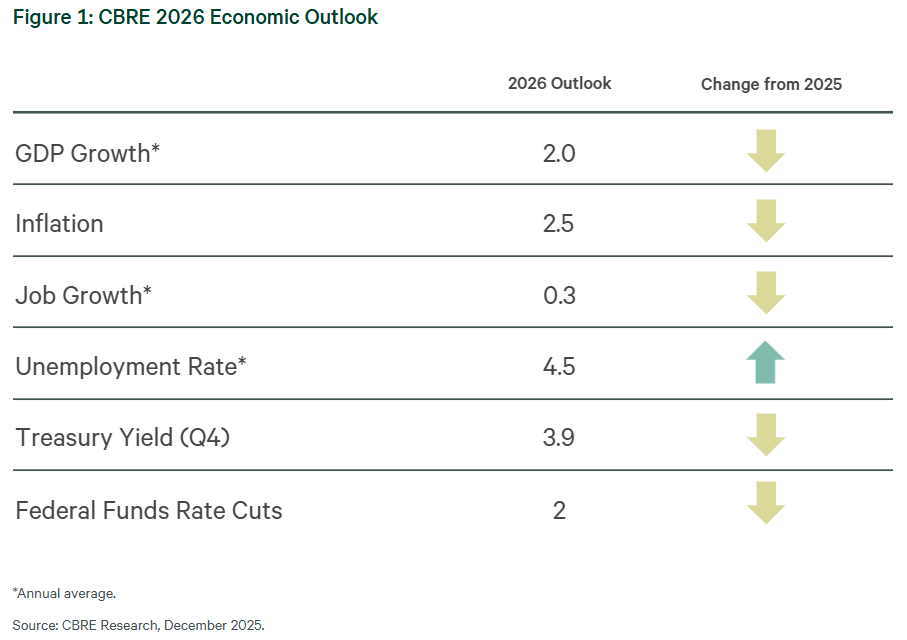
- The combination of persistent inflation and higher unemployment will complicate the Federal Reserve’s decision-making. Because price pressures are expected to fade later in the year, CBRE believes the Fed will focus on downside risks facing the labor market and cut the federal funds rate only twice in 2026 to a target range of 3.0% to 3.25%.
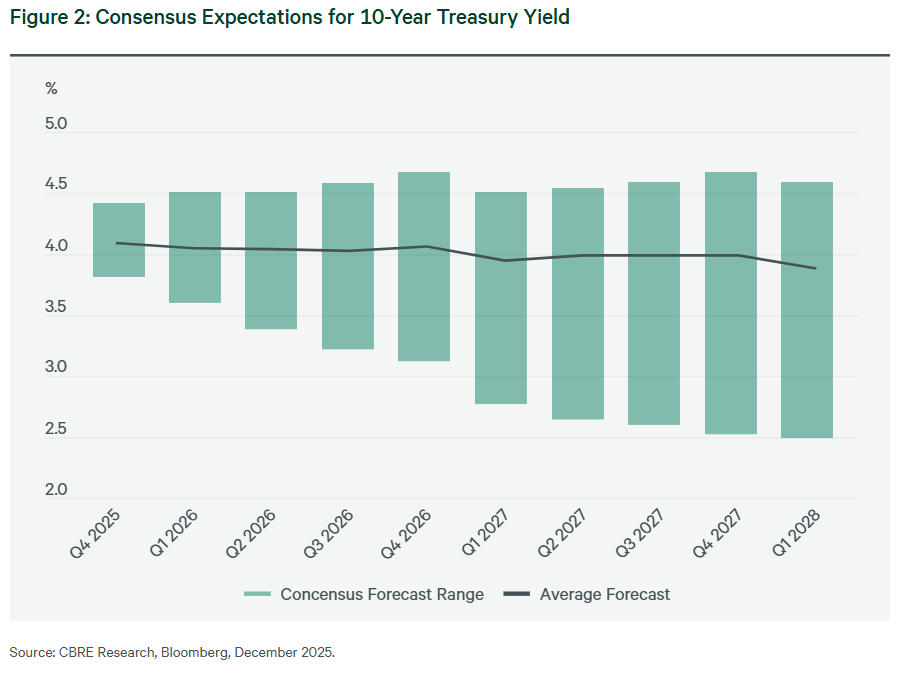
- The pathway for longer-term rates has decoupled from the federal funds rate. Aside from elevated inflation, concerns about U.S. debt levels are putting upward pressure on long-term Treasury yields. But the prospect of slower economic growth suggests that Treasury yields could end the year below 4%. Regardless, the yield curve will likely steepen, allowing financing via shorter-term credit to help drive commercial real estate investment volume.
Five expectations for the US hotel industry in 2026
- RevPAR will grow, but bifurcation holds
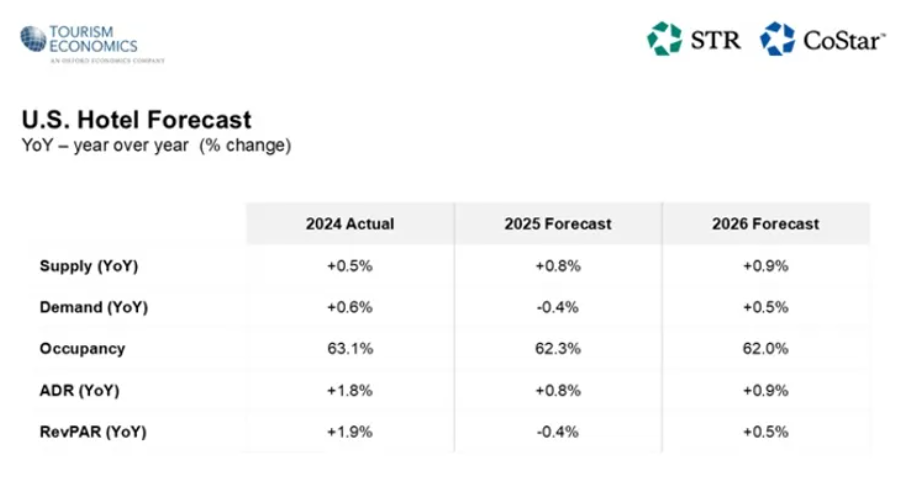
In 2025, U.S. hotel RevPAR fell 0.4%, a 220-basis-point decline from CoStar’s forecast released in late January. The 2026 results are expected to be as muted. However, at least we project positive RevPAR growth, albeit at a modest rate of 0.5%. Although macroeconomic growth is expected to be healthy, this positive momentum will not necessarily trickle down to the hotel industry. Companies will continue to manage margins closely, so travel budgets will likely be under scrutiny again.
We expect luxury-class hotels to show their usual room rate growth, which is near the rate of inflation, but we see no real catalyst for lower-end class hotels. As in 2025, we expect these hotels to continue struggling with driving occupancy and rates, and their RevPAR will likely remain under pressure.
The expectation is that in major metropolitan areas around the world, the room rate difference between luxury and ultra-luxury hotels will be over $1,000 per night. And many customers will pay the highest rate to purchase unique experiences.
- World Cup visitors will drive ADR, but demand will be uneven
The expanded 2026 FIFA World Cup field of 48 teams opened the door for teams from Cabo Verde, Curacao and Qatar. We expect most games to sell out, but when Curacao faces Côte d’Ivoire in Philadelphia on June 25, some seats will be empty.
U.S. hoteliers have high hopes for healthy room rates during match days. I just hope that revenue managers do not get ahead of themselves and then need to adjust rates as match days approach.
At the same time, meeting planners will avoid the 11 U.S. cities that host games between June 11 and July 19. Besides higher room rates, they do not want their attendees competing with fans for restaurants or event space. Anecdotally, I have heard that sponsoring companies have requested no internal meetings during the games, as their executives must attend events alongside the matches. For some companies, this may mean that their meeting planners are looking to compress a year’s worth of meetings into 10 months.
- Group demand will hold, but security around events will be tighter
Associations and trade groups still want their members to come and meet in person. We expect group demand to increase slightly in select markets, with room rate increases above the transient rate increase. Convention centers in some major markets, such as Dallas, Austin, and Houston, are undergoing renovations, which will likely cause groups to look elsewhere. Add to that the FIFA World Cup traffic that will deter meeting planners from certain markets, and some secondary meeting destinations may be the beneficiaries.
In an increasingly polarized environment, meeting planners may feel compelled to enlist third-party security to safeguard their speakers and guests from external disruptions. Hotel teams need to collaborate with meeting organizers to ensure that this enhanced security does not detract from the conference experience.
- Pipeline will still be muted, but renovations will pick up
The U.S. Federal Reserve continues to cut interest rates, which should encourage more development as hotel construction loans become cheaper. But with national RevPAR growth projected to hover around 0% — or decline in some instances — developer conviction in new development will remain hard to find. Overall, we do not expect a sharp increase in the hotel development pipeline.
With limited new competition on the horizon, many hotel owners will feel that now is the time to reinvest and revamp their property. After all, in many markets, a newly renovated property will not face new competitors for a while, allowing operators to maintain a competitive edge. One further impulse for hotel renovations is the property improvement plans, or PIPs, which are brand-mandated.
- Deal volume will increase, but distress remains elusive
The end of 2025 saw two noteworthy deals in San Francisco. Blackstone acquired the Four Seasons hotel, and the 3,000-room, two-pack Hilton San Francisco/Parc 55 was finally sold out of receivership. Deals of this magnitude will likely prompt other buyers to act, ensuring they do not miss out.
Outside of some noteworthy exceptions, such as the Hilton San Francisco deal mentioned above, the “wall of distress” has remained elusive. And a lower interest rate environment means that owners have even more opportunities to refinance their properties. This could lead to more hotel lifelines for owners and fewer forced sales.
Further cuts in 2025, 2026 US forecasts
- “We expect little change in the macroeconomic environment as unemployment and prices continue to rise,” said STR President Amanda Hite. “…ADR is growing well below the rate of inflation, which in turn will put more pressure on margins.”
- “We expect the U.S. travel economy to firm up moderately. Household income growth will continue, accompanied by tax cut benefits, resumed hiring, and less policy instability. Expanding global long-haul travel and World Cup interest will bring improved international visitation,” said Aran Ryan, director of industry studies with Tourism Economics.
“GOPPAR projections have been lowered from our previous forecast, with the decrease in 2025 being mainly due to higher expenses, especially in the F&B department, as well as increased costs in other operated departments, marketing, and utilities,” Hite said.

2026 Travel Outlook: What U.S. Hotel Revenue Managers Should Expect
Quick Facts: 2026 U.S. Hotel Outlook
- Growth will be minimal: Expect 62–64% occupancy, 1–3% ADR, and flat RevPAR.
- Demand shifts: Corporate transient and small groups rise, leisure evens out, and international inbound stays soft.
- Shorter booking windows: More last-minute bookings mean higher volatility and faster pricing decisions.
- Guest behavior changes: Travelers want value, personalization, and clear communication, not blanket discounts.
- Rate growth slows: Blanket ADR increases won’t work; success depends on segmentation and mix strategy.
- Where revenue will come from: High-value corporate dates, small groups, local events, and experience-based stays.
- Margin pressure increases: Rising labor and operating costs make missed pricing opportunities more costly.
- AI advantage: AI helps hotels react sooner to demand changes, optimize by guest type, and balance rate + occupancy better than manual pricing.
The Cheat Sheet for 2026
- Budget and forecast with conservative assumptions
- Focus on segmentation and guest type pricing
- Protect your high-value dates and blocks
- Use real-time pricing, not static rate bands
- Work short booking windows with confidence
- Build packages that feel personal, not generic
- Watch your local supply like a hawk
- Double down on direct booking performance
- Treat margin pressure as a strategy challenge
- Run upside, base, and downside scenarios for every key period
Additional Notes
- The 2026 results are expected to be as muted. However, at least we project positive RevPAR growth, albeit at a modest rate of 0.5%.
- With limited new competition on the horizon, many hotel owners will feel that now is the time to reinvest and revamp their property. In many markets, a newly renovated property will not face new competitors for a while, allowing operators to maintain a competitive edge.
- Continued trends for late booking and soft inbound international demand increase scrutiny needed by revenue managers for pricing around special events like the World Cup.
Links
- S. Real Estate Market Outlook 2026
- Five expectations for the US hotel industry in 2026
- Further cuts in 2025, 2026 US forecasts
- 2026 Travel Outlook: What U.S. Hotel Revenue Managers Should Expect
- Booking hotels within AI / What’s Next for Hospitality in 2026? / Market Snapshot: Hospitality Performance Entering 2026